


With the major work on boat jobs complete we had just over a day left in Santa Cruz. On the Monday we had the briefing for the next leg, over 3200 nautical miles from the Galapagos Islands to the Marquesas. When looked at on a projection of the world that’s a huge amount of nothing! Water, water everywhere…. The briefing covered the start line, the course, the finish and the formalities for clearing out of Ecuador and into French Polynesia. In the evening we had the prizegiving and dinner for the first leg. We’d won the multihull class again and this time had a prize, a lovely wooden Galapagos tortoise!
On our last night before the off, we went to a beautiful restaurant on the bay together with our friends from Ægle. Anne-Laure had already moved into a hotel for the last night so this was our opportunity to say goodbye as she headed home for a month. She’ll rejoin in Tahiti.


Start of Leg 4 – Galapagos to Hiva Oa, The Marquesas, French Polynesia
On Wednesday we were out by the start line in plenty of time, it was marked by two buoys with ARC flags and the World ARC team, Paul, Penny and Bev were on the starting boat. The forecast was for light winds and the ITCZ (the Inter Tropical Convergence Zone) better known as the Doldrums were going to be a challenge. This area of light winds and thundery squalls usually sits in a zone around the equator about the latitude of the Galapagos Islands. It usually goes as far south as 4 degrees South but this time is was expected to go as far as 8, 9 or even 10 South. Our plan from our routing was to concentrate on going South as fast as possible and not West (in the direction of the Marquesas) because we’d spend too long in the light airs and not enough in the wind.
The fleet got away cleanly at the start and by the evening we were passing Floreana again. We passed to the east of the island wih only about 3 or 4 other boats, the vast majority of the fleet headed to the West, a more direct route but (to our mind), wasting hours when they could have got closer to the wind which we knew was in the south. This was a decision on day 1 which was to pay off massively for us in the longer run.
Whilst we always want to sail (and managed to cross the Atlantic in 2018 and 2023 without using our engines), it was going to be impossible to cross the ITCZ without motoring. On days 2, 3 and part of 4 we clocked up a total of 45 hours and 29 minutes under engine, sailing when we could but heading south under motor when we couldn’t. That felt like a long time but I suspect it’s massively less than most of the rest of the fleet.


Weather Routing
Working out where to go when sailing across the ocean isn’t just a case of pointing at the finish and sailing a straight line, although following the shortest course is always the default option if there isn’t a good reason to do something else.
Yachts travel at different speed according to the wind strength and direction, we have data on this in the form of “polar charts”, see the image with concentric rings below, each ring is a different wind speed from about 4kts to 30kts, the distance from the centre is the boat speed expected for that combination of wind speed and direction.
We can also download raw weather forecast data, called GRIB files, which show the expected windspeed and direction hour by hour across our course. There are actually about 6 different models provided by different forecast agencies (like the Met Office). We tend to find that the ECMWF (European Centre for Medium range Weather Forecasting) and GFS (Global Forecasting System – US National Weather Service) are the most reliable sailing offshore in this part of the world.
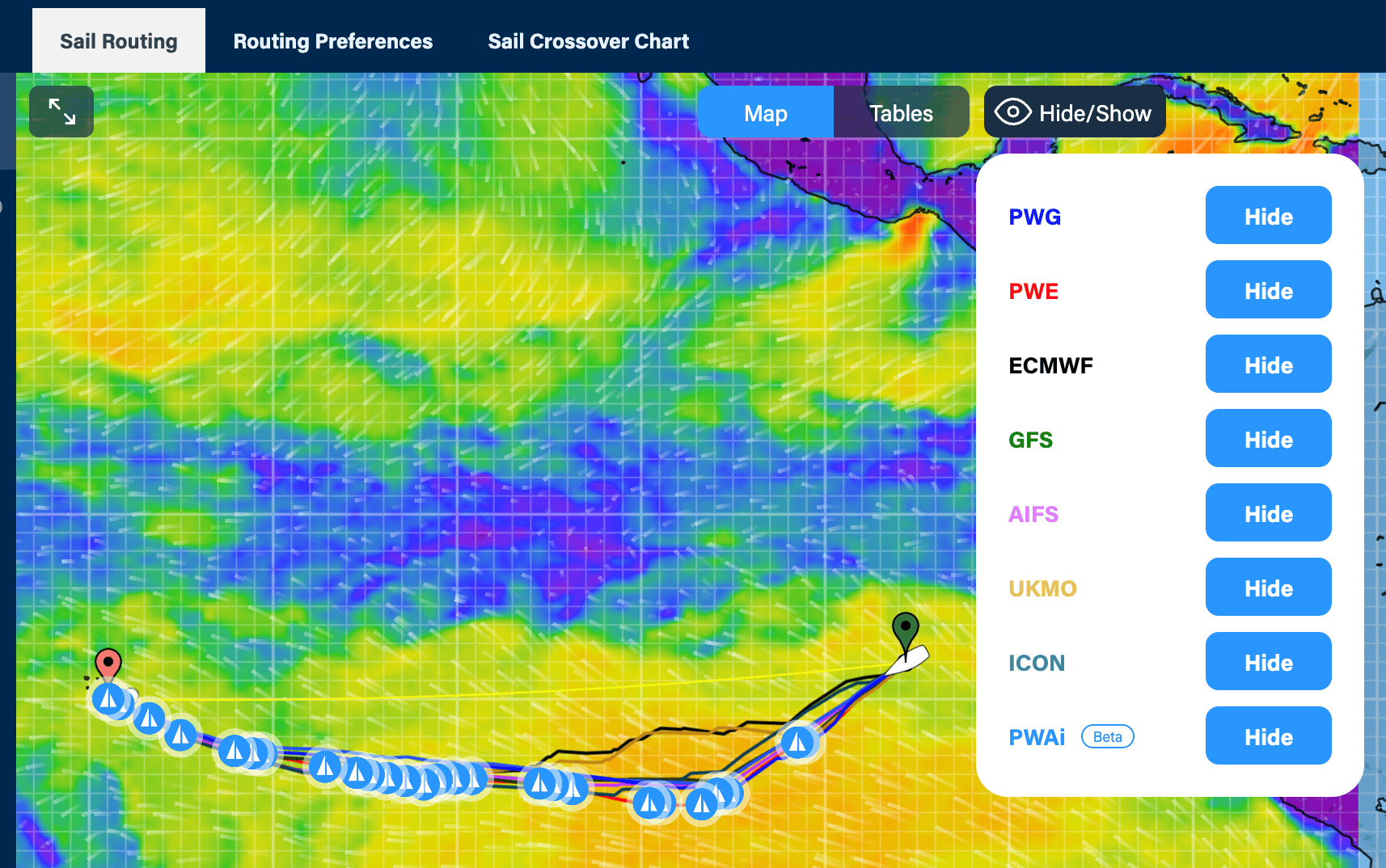
We can combine these two bits of information to determine the quickest way to get from A to B based on the combination of our boat polars and weather GRIBS. We use a service from PredictWind to run the software. Of course with 6 models this gives 6 different answers / routes. We then apply other local data (satellite photo imagery which is useful to see exactly where squalls (thunderstorms) are) and the weather we are actually experiencing (they are forecasts of course) and our experience of the boat to choose the route. See the 6/7 tracks on the routing below.
The route we actually sail might still be different from the routing. We might not want to use the “fastest” sail combination because conditions are challenging, it’s night, we see a squall system (see radar overlay with clouds below) etc.. We then have a strategy (go south until 12S latitude to get to the reliable wind) but then a short term tactical plan. We set waypoints to aim at, typically 2 days out, and then rerun routing specifically for that 300-400 mile stretch. We move the waypoint each time we rerun the routing.
Of course it’s a rally so we never look at how the other boats are doing on the YB Races leaderboard or where we are relatively!
We then repeat this process at least twice but often 4 times a day. It’s another way to keep busy but also means we are more likely to get there sooner.


How do we keep ourselves occupied?
We’re often asked: don’t you get bored on the long passage. On one level its definitely “Groundhog Day”. The routine is that the night watches (3 hours each) finish, we take breakfast individually, have lunch (salad), afternoon tea (Lucy’s Banana bread recipe is now perfected) and dinner (cooked with a rota). We eat lunch and dinner together. Repeat 18 times!
There is still plenty of “boat stuff” to keep us occupied. Before supper we will try to decide on which sails we want to use for the night as we want to avoid having to make changes in the dark if these are foreseeable. Weather routing is always in our mind and trimming the sails for comfort and performance.
We take showers daily as its so hot and sticky also mean we have to monitor water levels in our tanks and make more with the watermaker. This is power hungry so we also watch our battery levels and have to run the generator most evenings to top up as we don’t get solar power at night. We also have the usual domestic stuff: cleaning the boat inside (and out if we get rain); removing the nightly “catch” of flying fish; doing the laundry; even polishing the brightwork (thanks Phil).
The other boat item is “maintenance”. We had fixed all the major items before leaving Santa Cruz but the motion of the boat in the waves creates loads on sails and rigging and makes things rub together (ropes chafe quickly). So we are always checking. Lots of boats have had quite series problems on this leg: 2 boats tore their mainsails completely, several tore spinnakers, lots have chafed through reef lines, two have lost use of their engines (bad fuel for one and a broken gearbox on another). We have been fortunate, we snapped a preventer (a line to try to stop the boom moving uncontrollably and small lines holding down our Watt and Sea hydrogenerator have continued to keep Adrian and Phil occupied.


Fishing (!) and other leisure stuff
Our fishing has been remarkably unsuccessful. The score since the rally started is Fish Lure Thieves 5 – Successful Offbeat catches 1. We seem to catch enormous fish that break lines and take our lures with the solitary success of a single Mahi. Low point was an enormous strike that resulted in the fish nearly pulling me overboard and slammed me into the helm seat. Painful. Adrian and I were holding onto the rod which was going with the fish until fortunately the line eventually snapped! Our lack of competence has been shown up by the two family groups on Ruaj and Golden Hind who have been sharing their photos of their catches nearly every day!


Beyond that we’ve all been keeping ourselves busy: Adrian and Lucy reading lots; Phil and Adrian both having calls and planning for their roles as Chairman of two different RYA committees and I’ve discovered rediscovered by old software engineering background through the joys of “Vibe coding” using Cursor AI and Google Cloud to automate systems for this years J/70 racing season!
Sunsets, Sunrises and arrival!
The other Groundhog day experience is the ritual of sunrise and sunsets. The view of the sails hardly change but our perspective does. The sun’s arrival and departure is stunning nearly every day and the passages at night with the trillions of visible stars are really humbling reminders of the tiny specks we are in the cosmos. Sometimes good to remind us in these crazy times. Often nothing changes at night but occasionally we run into a Chinese fishing fleet with AIS beacons on their lines to give us something to do.


Final day
The last day has been different. We finally saw another yacht for the first time in 2 weeks; a German Hallberg-Rassy yacht called Kirke. They have spent 4 weeks doing the same passage (now that’s a real slog). We passed them quickly we were doing 8 knots, they were only doing 4! We called on VHF, exchanged contact details and took photos of each other.
This morning we had our final sunrise a few hours ago. This one was rather different. We could see land when the sun came up. Hiva Oa in French Polynesia
We finally crossed the line today at 0913 local time (UTC-9) , 1843 UK time after 3413 nautical miles across the south Pacific and almost exactly 18 days. An epic voyage with a fantastic crew! Now to anchor, shower, go ashore, check-in to the country and take a breath to relax!


Most exciting and interesting as ever. So pleased you’ve safely reached land again. Enjoy getting used to walking on terra firma before setting off once more. 👍
Congratulations Dave, Lucy, Adrian & Phil on another successful leg. Epic voyage and fantastic result. Hope you get another prize. 😉 Loved following you and reading the blog; enthralling. Almost makes me want to join you! 🙃 I noticed that we are just on the edge of the Mercator projection!! Enjoy exploring the Marquesas. Steph xx
Well done guys! Interesting reading as always! Hope you get more luck with the fishing on the next leg!
Wow! That’s it I’m afraid. Just wow!